Hello, I'm Chesca!

Welcome to my portfolio!

About Me

I am a Bachelor’s Degree holder in Communication Arts from De La Salle University and currently pursuing an MA in Digital Media at the University of Leeds. As a 25-year-old and the eldest of five, I’m passionate about using social media to connect, share stories, and convey impactful messages. I aim to advance my career by leveraging digital tools to create a positive societal influence.

Download My Resume

Reflections

Week 2

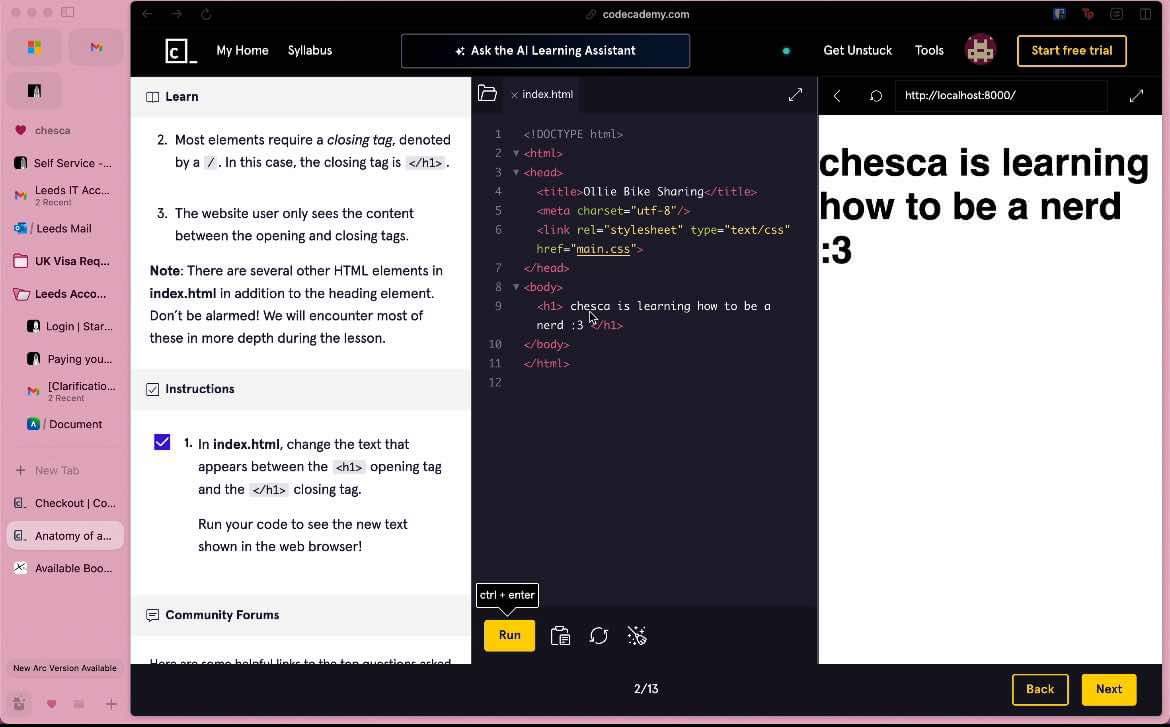
For week 2, we had our very first workshop which involved learning about coding and data! This was one of the things I was quite nervous yet excited to learn about! My boyfriend is actually an analytics engineer and his work was something I was always curious about, and so I was more than happy to participate in this activity.

We were given links and workshop tasks to read and go through to better prepare us for the activity itself, and I can say that it was a bit confusing at first, but with the help of our lecturers and the guides, I managed to pull through in the end.

After the end of the session, I left the lecture halls with new information and a sense of excitement with the chance to work on my own portfolio/personal website!

Week 3

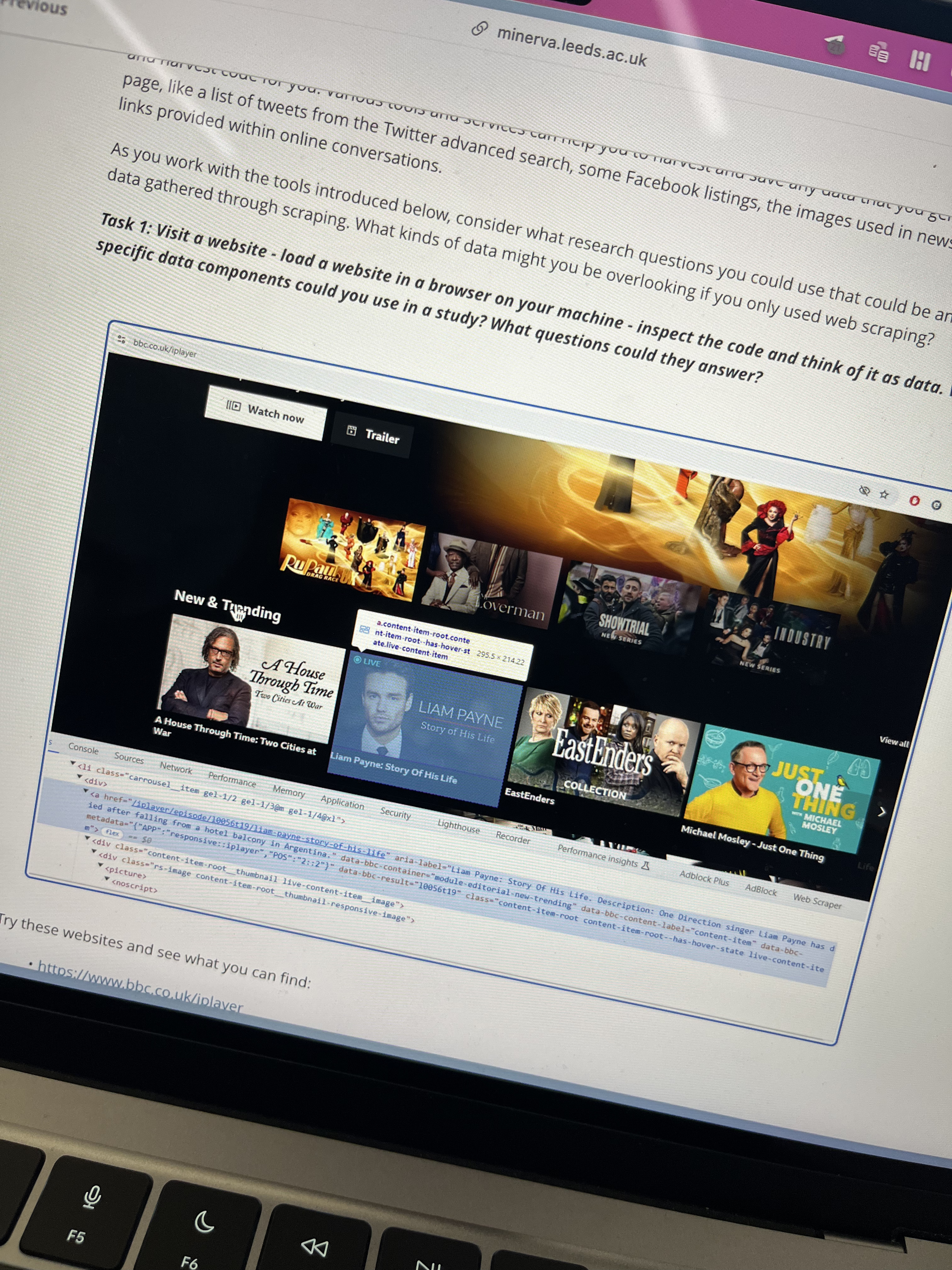
Week 3 involved a new topic still related to coding and other digital practices. In my case, this workshop seemed a bit more challenging, as it involved collecting data from other websites. Dr. Chris Birchall taught us the basics of how to scrape data from the web and collect it, which may be useful for our own research projects.

Before the workshop, I took extra time to understand what needed to be done by using LinkedIn Learning. If I may be honest, it felt a bit like information overload, as there were numerous videos one after the other. However, having short quizzes at the end served as a breather and helped me retain the information that was just presented.

During the class itself, I was thankful to have the step-by-step guide included in Minerva, which helped me avoid feeling overwhelmed by all the information. I could easily refer back to it for further review!

Week 4

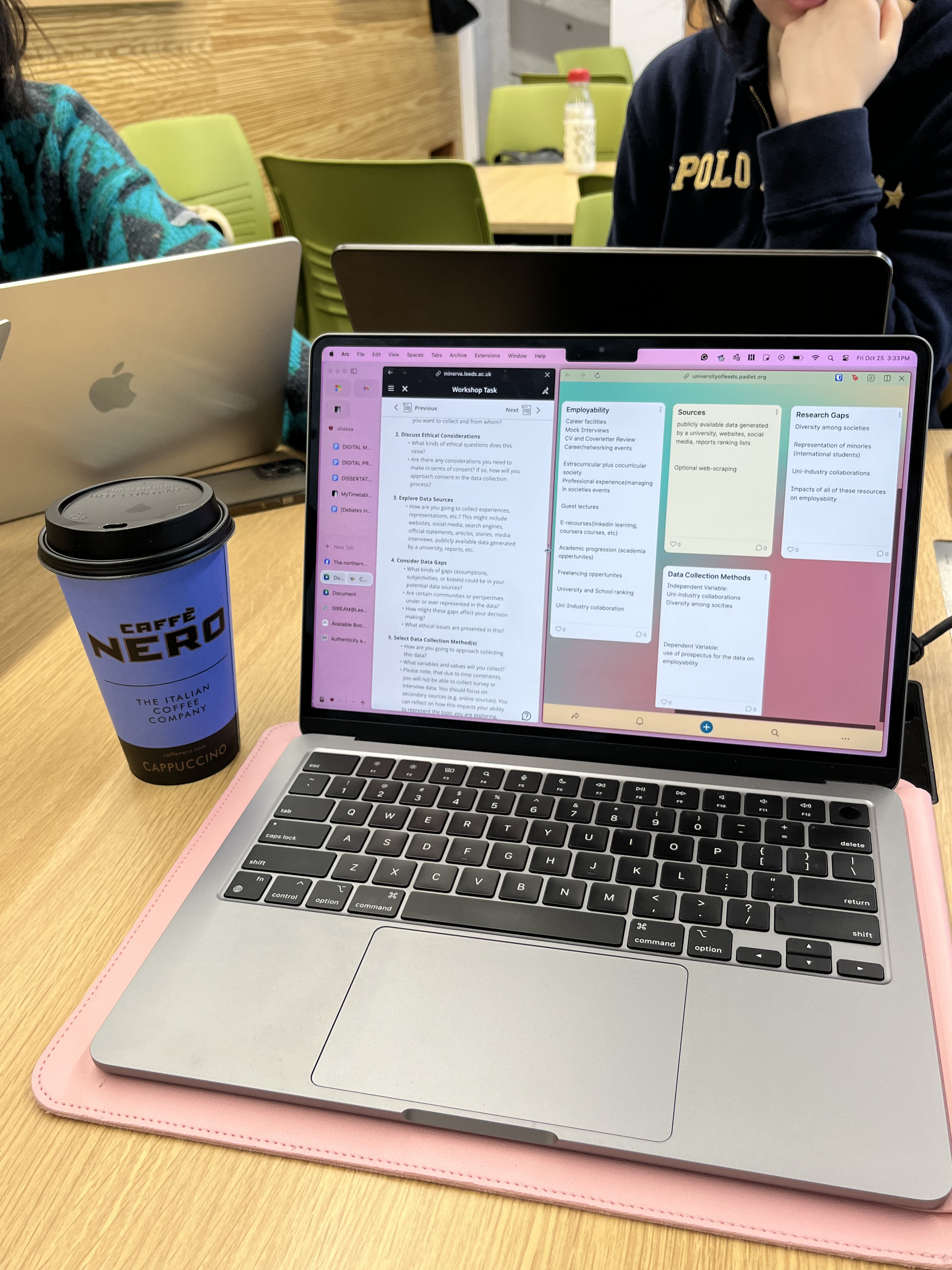
For week 4, we delved into data and data analysis! In addition to our required readings, we were tasked with collaborating with our classmates to choose from a few scenarios, with context provided by Holly herself, which would allow us to imagine data. I was part of “The Digital Team,” and we chose Scenario 1: Student-led Data Collection.

Our task was to collect and analyze data that would help the group understand the student experience. In our case, we came up with several ideas, and Holly offered her guidance on what might be best to focus on, as well as the limitations and research gaps that could arise.

Since this was one of our first collaborative workshops, I found it very fun and interesting to hear ideas from fellow coursemates! Although it was cut short by a fire drill, I’m looking forward to the next session when we can start collecting data and working on our datasets!

Week 5

Our workshop session for week 5 was quite delayed so I had to review what we had done as well the week before. Fortunately enough we had continued discussing data but this time fovusing on data visualization! Based on the given readings this week and what we’ve discussed during our lectures, data representations help in transforming more complex data into something that we can easily interpret. I recall reading from the article of Kennedy, H. & Hill, RL (2017), how they mentioned that the purpose of a visualization shapes how things are designed as well as its style and tone, and how much interaction and engagement an audience is meant to have with it.

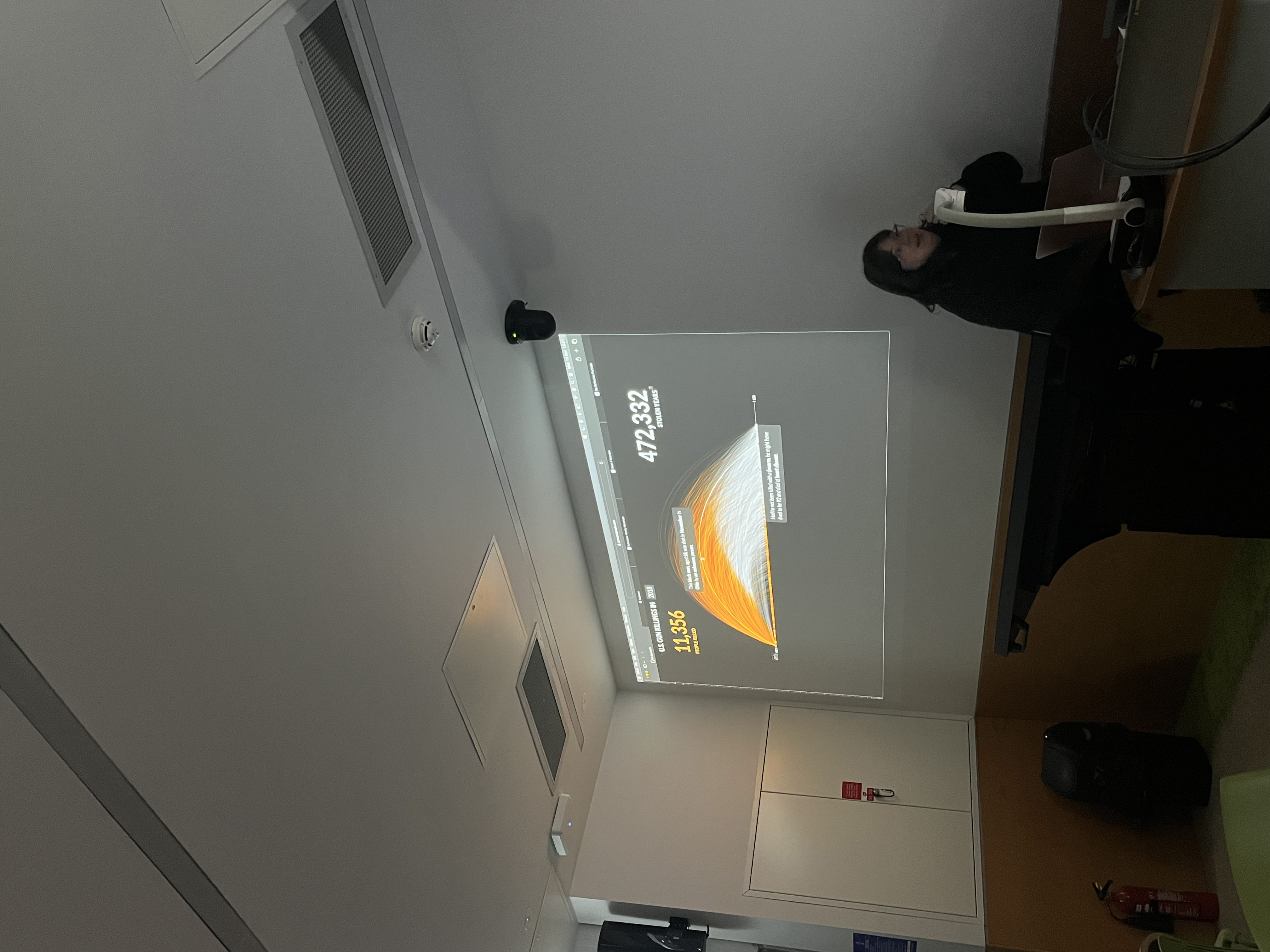
Holly showed us an interactive data visualization set of U.S. Gun Killings in the year 2018 alone where around 11,356 people were killed and past that it showed the amount of stolen years from each of these people’s lives which amounted to 472,332. It was really interesting to see and I found that the way this was presented was really effective in showing the fatalities just by the use of guns alone and perhaps the lack of gun control in the US. I remeber taking note of something that Holly said in relation to this topic that stuck with me and that was "people are not data points (there are other ways to humanize them).”

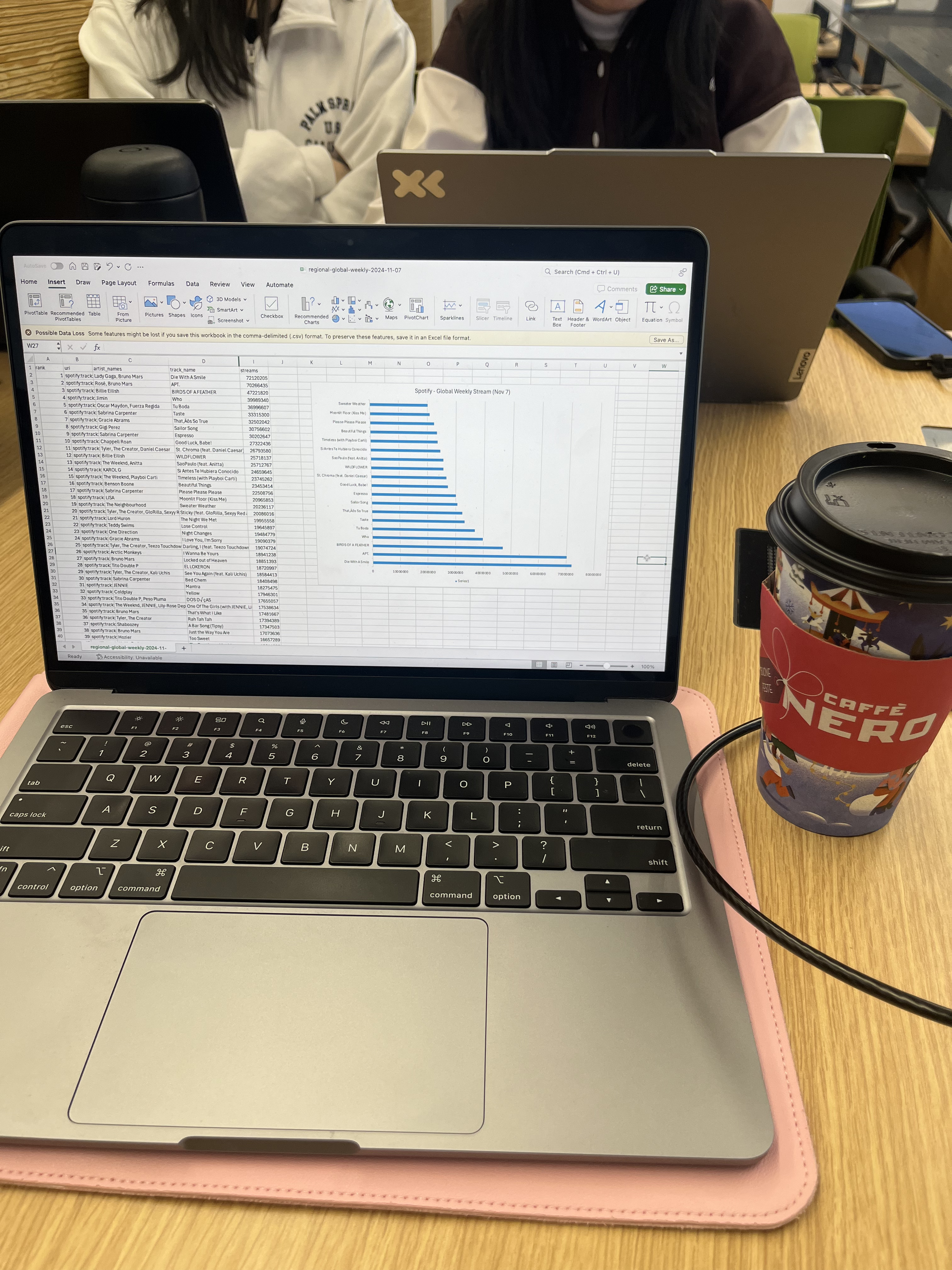
Other than that, we also had time to test our own data sets or even try out some of the data published in Minerva! I saw that they had Spotify on there and since I love listening to music, I decied to try that one out. We were tasked to use the data sets and visualize them by placing them into charts on excel. By doing this, I was able to see what songs and artists were currently popular for the week and it gave me a clearer picture of global music trends and how we might consume music based on what’s up and coming or gaining attention on streaming platforms such as Spotify.

Week 7

For week 7, we delve into the use of machine learning and facial recognition. Based on the given reading, we can understand how the authors Scheuerman, Pape and Hanna (2021) point out how the use of facial analsysis technologies being used for things such as identity recognition and surveillance assets some form of gender classification and are often viewed under a biased gaze that mostly makes use of western models/bodies. There may also be specific facial expressions that are more common for other gender roles. I particualrly remember an image from our Week 6 lesson on ‘Creative Computing, Senses and Bodies’ where we were shown an image of highly revered scientists which mostly comprised of men. When it was detecting their expressions with a straight face, each of the men were labelled as neutral. However, when it Marie Curie with the same expression, she was labelled as “angry.”

Unfortunately I belive this is very common and have seen a lot of instances online of how this kind of technology can mislabel people. essentially it somehow reinforces racial and gender biases which can cause several mistakes. When it comes to auto-essentialization, there are a few problems or dangers that are direcyly related to automated facial recognition such as bias and discrimination which I have preciosyly mentioned, as well marginalization. In this sense, the reading also noted how here are people who do not conform to their recognized gender binary such as those who identify as transgender and this can lead to them being misidentified. Before the workshop, aside from the reading we were also asked to checkout Facework which is a creative project that offers a critique of AI. Here I was made to show different facial expressions that supposedly was asscoiated with different jobs and if I matched the facial recognition, I would receive ’tips’ and move on to the next ‘job.’ I noticed how they were simply classified by gender, race and even if it was not directly related to the description, there had to be a certain facial feature to match. To be honest, I found this a little creepy and leaning into the “Black Mirror” type of technology seen in the show. But by the end of it all, it really showed me how easy it is to be labelled and discrimianted for how we look.

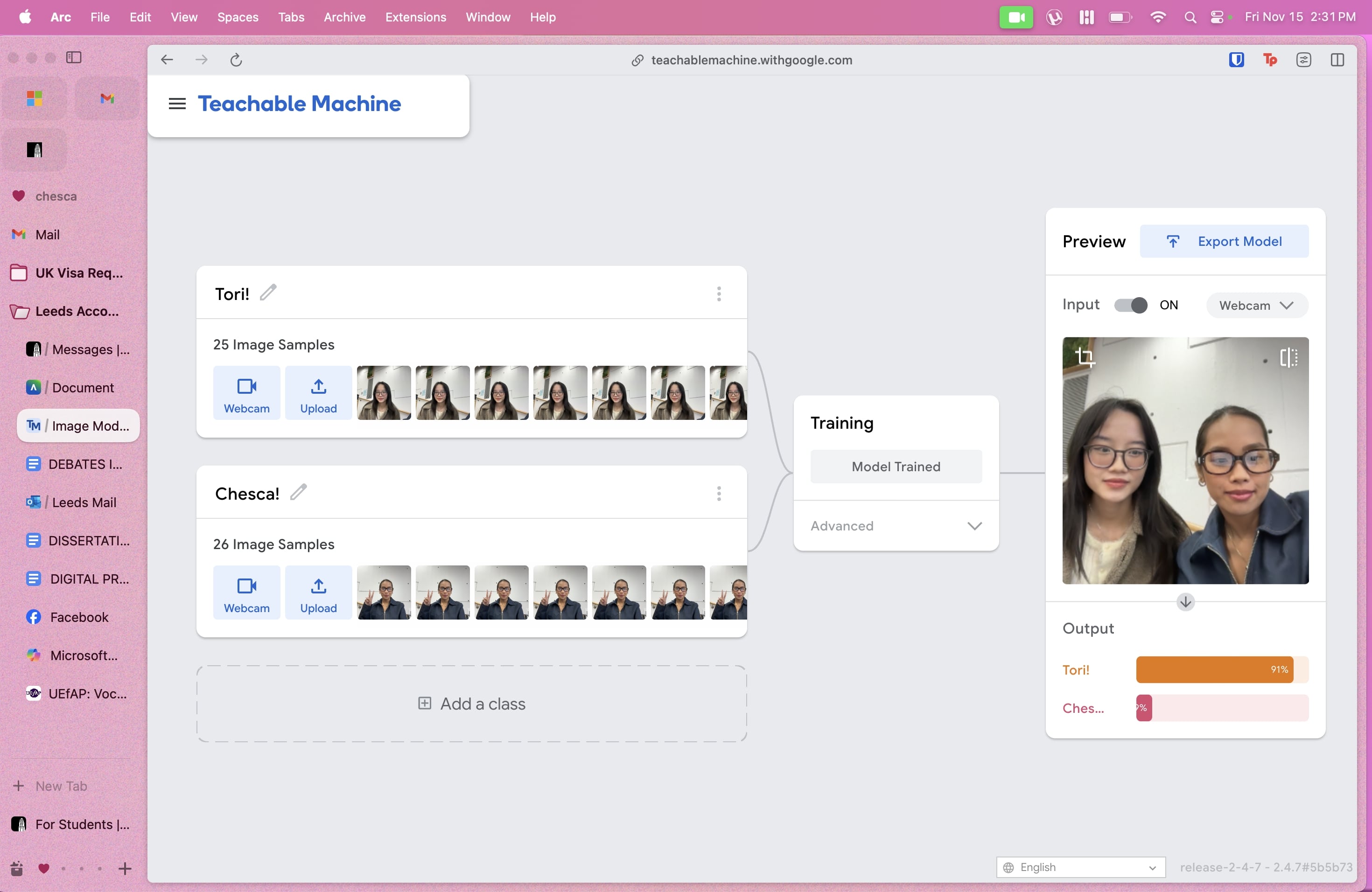
As for the workshop itself, we explored Teachable Machine and I was able to work with one of my classmates Tori wherein we tried to train a model to distinguish which one was which. We even ended up tricking it to get confused and even when I was present in the image, majority of the detection done by the machine was pointing to Tori! By the end of this session, I realized how facial recognition technology offers many benefits but also raises concerns about privacy, bias, and fairness, especially for marginalized communities. It’s important to balance the benefits with ethical considerations to prevent misuse and ensure fairness for everyone.

Week 8

For week 8, our topic was on Identity, Algorithmic Identity and Data! Our required readings on Sumpter and Cheney-Lippold introduced these concepts but for the very first task of the workshop, we focused on algorithmic identity. We were tasked to visit any of the soical media platforms we frequently visit and explore what kinds of data the platform collects from us as well as what we input. In my case I was surprised to see how Instagram was able to have data of all the interactions I have done on the appp. From the likes, comments, to story replies as well as reviwes. It felt a bit weird to see the very first few interactions I’ve had as I seemed to be much more open a few years back, and as I’ve matured I’ve learned to be more private and careful with what I post and share online. We were also tasked to visit Facebook and and head to the accounts centre to check what type of ad topics we were supposedly being targetted with. This aligns perfectly with Cheney-Lippold’s definition of ‘algorithmic identity’ wherein it refers to the algorithms through the analysis of data points like online behaviors, preferences and the like. When I checked mine, it was sort of accurate for some topics such as travel and currency exchange since I’m currently an international student studying here at the university! Even if I had never looked at other products specifically on Facebook or Instagram, certain products I’ve viewed on other websites would appear in these two platforms as well because of these ‘cookies’ and algorithms being tracked by my data. I still find it creepy how all this is possible and it’s made me more cautious on what I search, what I post and view online.

For the second part of the workshop, we were tasked to do our own version of Sumpter’s method wherein he classified his friends into different categories based on interests and behaiors such as jokes/memes or music/film/sports. We carried this task over the week and given that this was manual scraping it did take a much longer it allowed me to learn more about my friends and their activties as well. But I also realized that our online idenitities are a blend of what we choose to share online and what these “algorithms” guess about us are simply based on our interactions on these platforms and what data we give it. While some parts of our what my friends share online are true, they often show a more ‘curated’ or ‘polished’ version rather than their complete, true selves. So what I can conclude is that these algorithms can either simplify or distort our identities and are merely a fragmet or even only partly true to reality.

Week 9

For week 9, we dabbled on the topic of digital ethnographies. But before proceeding with that task, we summed up our learnings from the task on Week 8 about identiy, algorithmic identity and representation. In his work, Sumpter explains that while these categorizations help platforms like Facebook optimize user engagement, they often oversimplify the rich and complex nature of our human connections. These algorithms reduce our multifaceted relationships to mere data points, which can then be analyzed, marketed, or influenced. This ties towards my experience with the workshop as well. Since I had to assign my friends to certain categories I had to place certain labels based just on their photos alone. But as I mentioned during my realizations at the workshop, these don’t show the true personalities of my friends and they can be quite different with how they present themselves when they are offline vs online.

Moving forward to the next task, we discussed digital ethnography and the implications on said topic. For the assigned reading by Pink et. al, the chapter delves into how digital ethnography allows researchers to dive into the dynamic and interconnected "social worlds" we live in. It highlights that these environments are shaped by a mix of digital, material, and other interactions, that researchers must use adapatble and ethical methods in order to study their chosen subjects and environments effectively. In line with our task for this week, we had to choose an online community that we would consider ourselves a part of that shares some form of insider knowledge. For my case, I chose the group Subtle Asian Traits on Facebook which is a community group I joined during the pandemic. The mission of this group is to connect Asian individuals globally to create a community that celebrates the similarities and differences within the subtle traits of Asian culture and sub-cultures. I shared this among my group and gave them the basic information about it such as typing the name of the group on Facebook and before you can officially join, the admins of the group will check on whether they approve or diassprove you to join said group. As of this date, there are over 1.9 Million members of the group as well! When I shared this among my classmates, they noticed how the group was very respectful and lively, and that it was not being used for sponsorships or to promote products which they noticed was happening in their chosen groups.

To sum up everything from this week, Pink et. al, as well as Sumpter’s ideas analyzed how digital platforms influence our identities and the ways we present ourselves. Pink et al discussed how our “social worlds” are shaped by through both digital and physical interactions which means we need to partake in ethnographic methods to have a better idea on the influence of digital media. This I believe ties to Sumpter’s critique of how algorithms simplify our complex relationships into basic metrics, shaping algorithmic identities that influence how we perceive ourselves and engage with others.

Project

Brief description of Project.

Contact

Feel free to reach out via email: tzdl2835@leeds.ac.uk